Catégorie : Ici et ailleurs
-
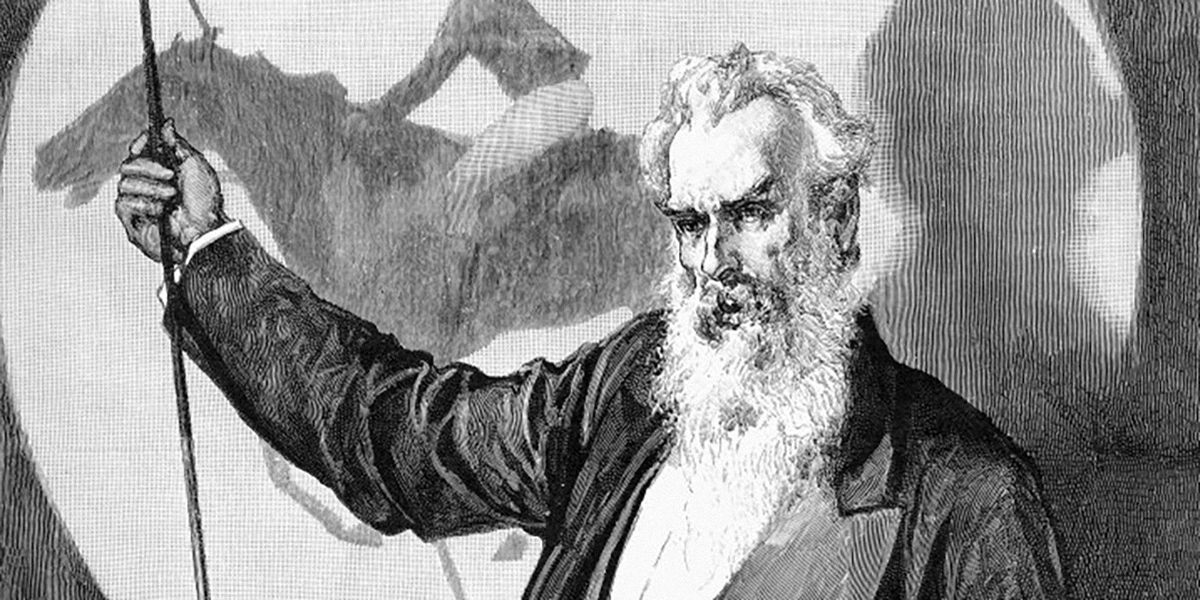
Eadweard Muybridge – Tate Britain
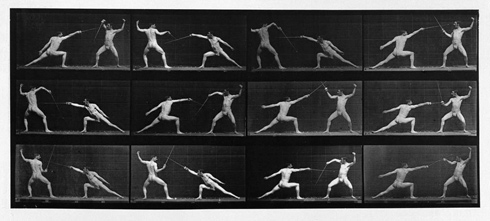
Eadweard Muybridge
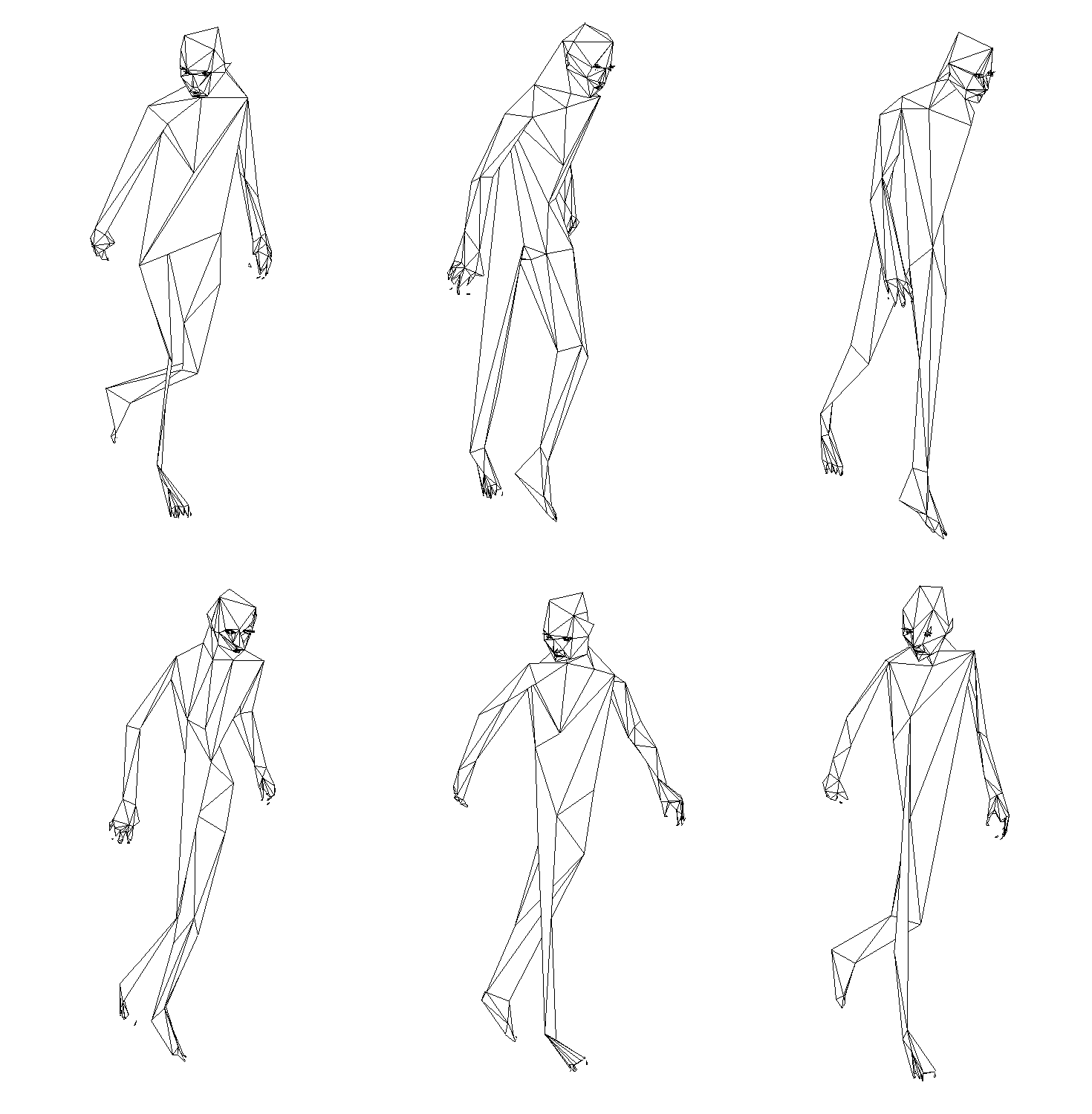
Fencing (Movements Male), Plate 349, 1887Muybridge was the man who famously proved a horse can fly. Adapting the very latest technology to his ends, he proved his theory by getting a galloping horse to trigger the shutters of a bank of cameras. This experiment proved indisputably for the first time what no eye had previously seen – that a horse lifts all four hooves off the ground at one point in the action of running. Seeking a means of sharing his ground-breaking work, he invented the zoopraxiscope, a method of projecting animated versions of his photographs as short moving sequences, which anticipated subsequent developments in the history of cinema.
British-born Eadweard Muybridge, who emigrated to the United States in the 1850s, is one of the most influential photographers of all time. He pushed the limits of the camera’s possibilities, creating world-famous images of animals and humans in motion. Just as impressive are his vast panoramas of American landscapes, such as the Yosemite valley, and his documentation of the rapidly growing nation, particularly in San Francisco. His dramatic life included extensive travels in North and Central America, a career as a successful lecturer, and the scandal of his trial for the murder of his wife’s lover.
This exhibition brings together the full range of his art for the first time, and explores the ways in which Muybridge created and honed his remarkable images, which continue to resonate with artists today. Highlights include a seventeen foot panorama of San Francisco and recreations of the zoopraxiscope in action. His influence has forever changed our understanding and interpretation of the world, and can be found in many diverse fields, from Marcel Duchamp’s painting Nude Descending a Staircase and countless works by Francis Bacon, to the blockbuster film The Matrix and Philip Glass’s opera The Photographer.
Eadweard Muybridge,
Tate Britain, 8 September 2010 – 16 January 2011
Source : https://www.tate.org.uk/ -
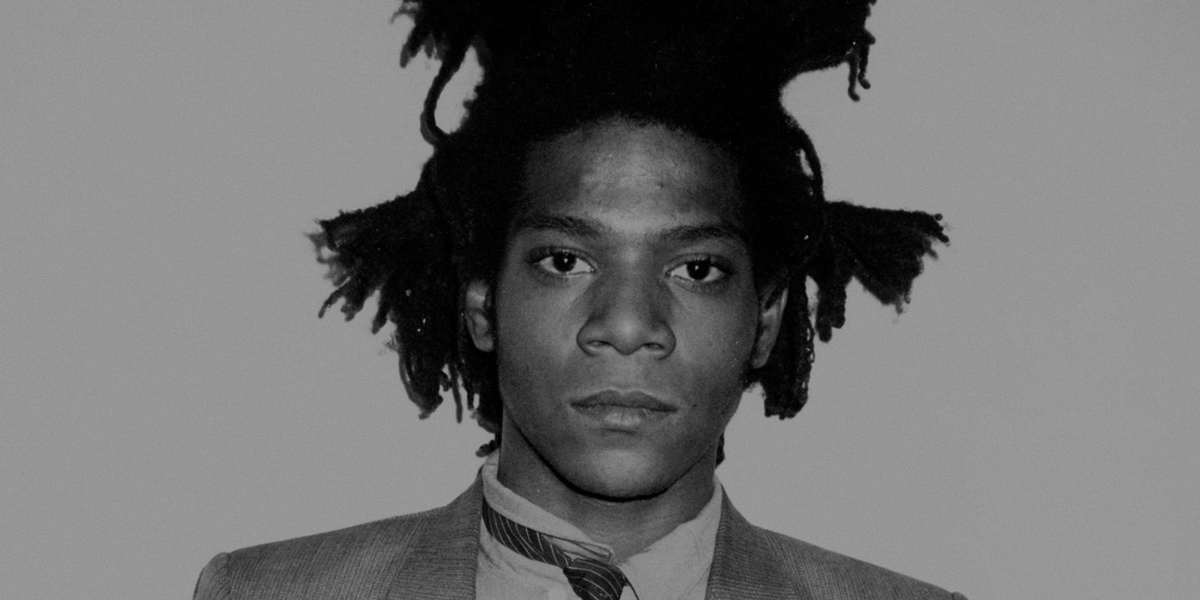
Jean-Michel Basquiat à Paris
Première grande exposition rétrospective de la fulgurante carrière artistique (entre 1979 et 1988) de Jean-Michel Basquiat au Musée d’Art Moderne de la ville de Paris. Plein les yeux avec les tableaux et dessins de tous formats sur tous supports, d’un artiste au carrefour graphique de l’art contemporain, l’art brut, l’art primitif, le pop art et le graffiti.
Jean-Michel Basquiat fait partie des pionniers de l’art contemporain par l’importance et l’abondance de son œuvre.
Graffiteur au style percutant et original puis peintre virtuose capable de véhiculer un message spontané, enfantin et à la fois effroyablement sérieux, son oeuvre pointe vers une nervosité et une violence bien particulières, caractéristiques très représentatives du personnage qu’il était.
Basquiat était un artiste avant-gardiste qui a su comment abattre les banalités au profit de l’art. Regard sur l’un des piliers de l’art et sa contribution déjà très reconnue dans l’histoire.Basquiat, Musée d’art moderne de la Ville de Paris,
11 avenue du Président Wilson, Paris 16e,
tous les jours sauf lundi et jours fériés, 10h-18h,
nocturne le jeudi jusqu’à 22h.Du 15 octobre 2010 au 30 janvier 2011
-

Nouveau portail pour l’Éducation artistique et culturelle
Le site internet pour l’histoire des arts au ministère de la Culture de la Communication fait peau neuve.
Prioritairement conçu pour la communauté éducative, il signale pour tous les domaines artistiques et culturels des documents en ligne présentant une oeuvre ou un groupe d’oeuvres. Le site s’organise en fonction du nouvel enseignement de l’histoire des arts : grands domaines artistiques, périodes historiques, thématiques.
Il permet d’accéder directement à quelque 4000 ressources pertinentes au regard de ce programme. De nouvelles ressources alimenteront cet annuaire d’ici la fin de l’année.